Insights • Healthcare operations • governed AI

Dynamic Data Agent for EMR-Connected Clinics

Reduce administrative burden and facilitate quicker, safer decision-making by transforming routine clinic inquiries into controlled, read-only retrieval workflows that combine policy intelligence with real-time EMR context.

EMR-connected insights Read-only dynamic queries Clinic productivity HIPAA-aligned governance

This document presents a conceptual reference architecture developed by the TraceCounts engineering team. It outlines a proposed framework for integrating AI-based dynamic data agent for EMR connected clinics. Especially useful in regulated clinical settings where stringent data exposure controls and robust auditability are necessary.

Overview

Clinics manage an extraordinary volume of information, yet much of it remains difficult for staff to translate into clear, actionable guidance. The EMR holds the clinical record, and organizational policies define how care must be delivered, but in practice employees still spend significant time reaching out to multiple departments to clarify routine policy questions. This article examines how a governed Dynamic Data Agent, operating through a secure, read only connection to the EMR, can streamline these everyday workflows and strengthen staff capacity to support patients with greater speed, accuracy, and confidence.

EMR connected workflows Read-only governed insights Audit ready AI responses Role based visibility

Section 01

Executive Summary

Clinics generate and manage vast amounts of operational and clinical information, yet staff often struggle to turn that information into timely, actionable guidance. The EMR holds the patient record, and organizational policies define how care must be delivered, but routine questions still require employees to reach across departments, search multiple systems, and manually interpret rules. This creates avoidable delays, inconsistent answers, and unnecessary administrative burden.

A governed Dynamic Data Agent addresses this gap by converting everyday questions into controlled, read only retrieval actions that unify approved policy guidance with real time EMR context. The approach strengthens decision quality while preserving the integrity of existing systems and access boundaries.

  • Delivers a single, governed response that blends policy knowledge with live operational insight.
  • Enforces role based and department scoped visibility before retrieving any information.
  • Operates strictly in read only mode with limits and timeouts to protect EMR performance and data integrity.
  • Generates auditable evidence so results are consistent, reproducible, and defensible.
a governed Dynamic Data Agent for EMR-connected clinics.
Supporting care decisions with controlled intelligence.
Abstract stream of transaction data moving through a digital network.
From Data Saturation to Clinical Intelligence

Section 02

Context & Problem Landscape

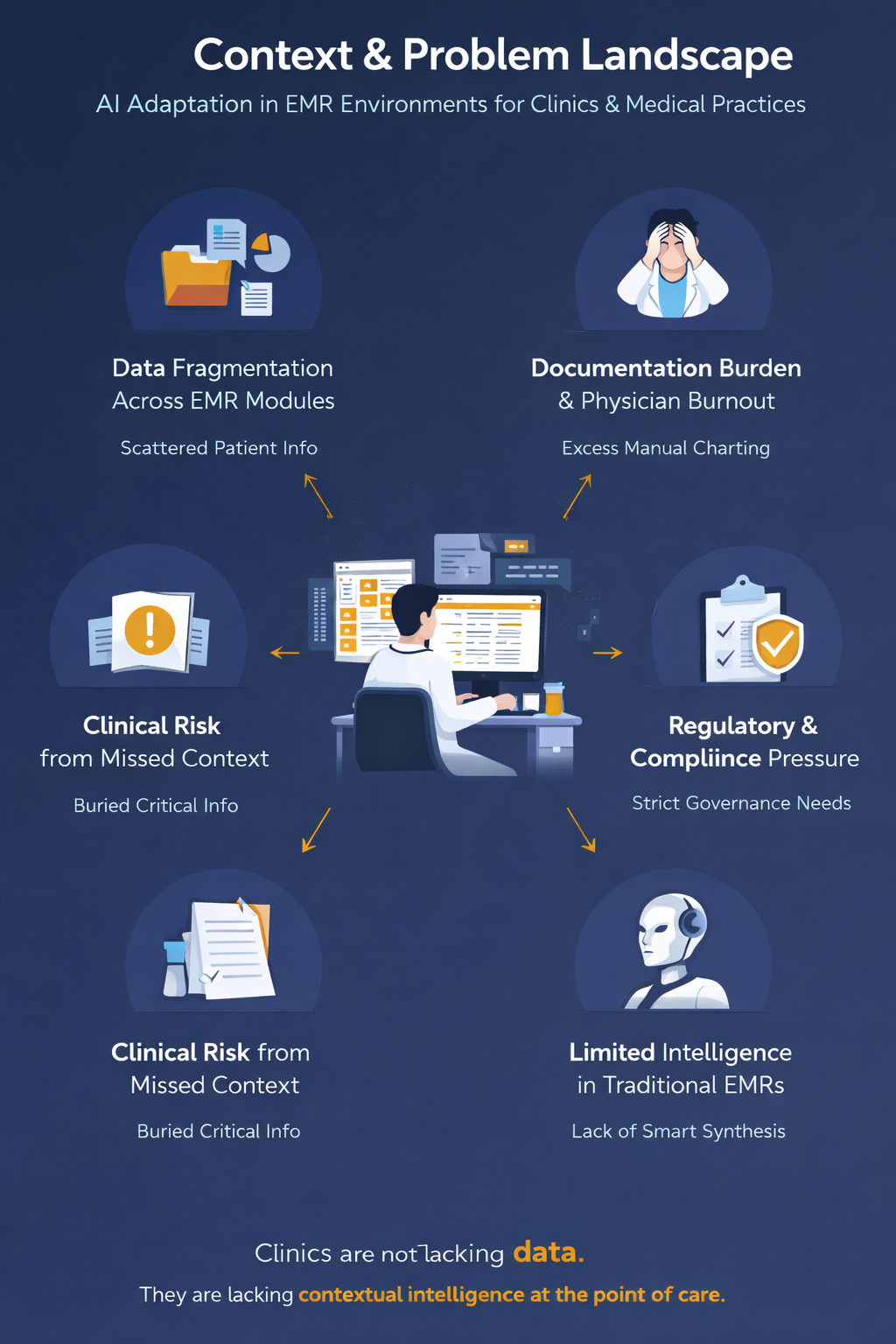
Clinics rely on EMRs to capture large volumes of clinical and operational data, yet much of that information remains difficult to translate into clear, timely insight. Providers often move between modules, historical notes, and policy documents just to confirm routine details, adding cognitive load and slowing care during already compressed encounters.

Traditional EMRs excel as systems of record but offer limited support for real time synthesis or governed decision assistance. Important context may sit in free text notes, scanned attachments, or longitudinal trends, leaving clinicians to manually piece together the full picture. As documentation demands grow and compliance expectations rise, this gap between data availability and actionable intelligence becomes more pronounced.

Emerging retrieval grounded AI capabilities offer a path forward. By layering governed, context-aware intelligence on top of existing EMR systems, clinics can enable real time retrieval of patient specific context, unify policy and clinical information, and maintain full traceability to source records—all without disrupting established workflows or altering system of record boundaries.

This approach positions AI as a supportive intelligence layer rather than a replacement technology, helping clinics reduce cognitive burden, strengthen compliance, and elevate the quality and consistency of patient care.

Section 03

Why Generic Chatbots Fall Short

Generic conversational AI tools are not built for the clinical, regulatory, and workflow realities of healthcare settings. In EMR environments, intelligence must be contextual, traceable, and patient-specific; not generic. They often miss the clinical, operational, and policy context needed to provide safe and reliable guidance. As a result, they create friction rather than reducing it.

Key limitations include:

  • Lack of patient-specific context - Responses are not grounded in the clinics EMR data, leading to generalized outputs.
  • Inability to interpret longitudinal history - Static prompts ignore trends, comorbidities, and evolving clinical patterns.
  • No traceability to source documentation - Outputs cannot be easily audited or verified for compliance.
  • Oversimplified reasoning - Subtle clinical signals may be missed without structured retrieval.
  • Workflow misalignment - Generic tools operate outside the EMR, creating friction instead of efficiency.
Why Generic Chatbots Fall Short in Clinical Environments.
Clinical AI must be governed, contextual, and defensible.
“Introducing Dynamic Data Agent for EMR-Connected Clinics.
An Intelligence Layer Designed for Clinical Reality.

Section 04

Introducing Dynamic Data Agent for EMR-Connected Clinics

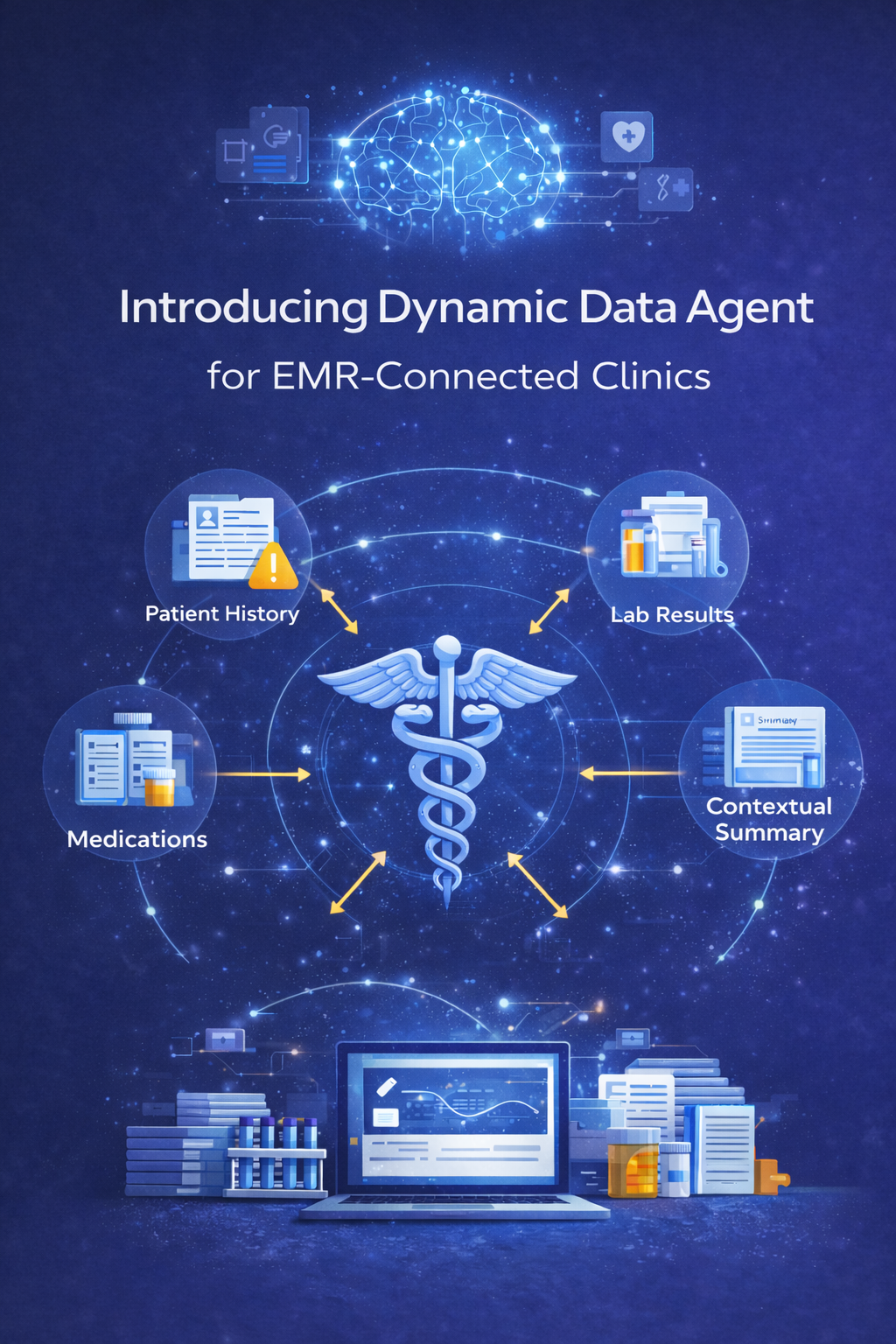
The Dynamic Data Agent functions as an intelligent retrieval and synthesis layer embedded within EMR-connected clinical environments. Rather than producing generic outputs, it securely evaluates patient records in context — analyzing patient history, evolving clinical patterns, and retrieving structured data to deliver grounded, explainable insights at the point of care.

By dynamically retrieving relevant notes, lab results, medication history, and prior encounters, the agent supports consistent clinical triage, contextual summarization, and documentation assistance in real time — without disrupting established workflows.

Core capabilities:
  • Longitudinal patient history analysis
  • Context-aware EMR retrieval
  • Real-time identification of clinically relevant signals
  • Traceable outputs linked to source documentation
  • Governance-aligned integration within clinical workflows

Section 05

Clinic Impact & Practical Benefits

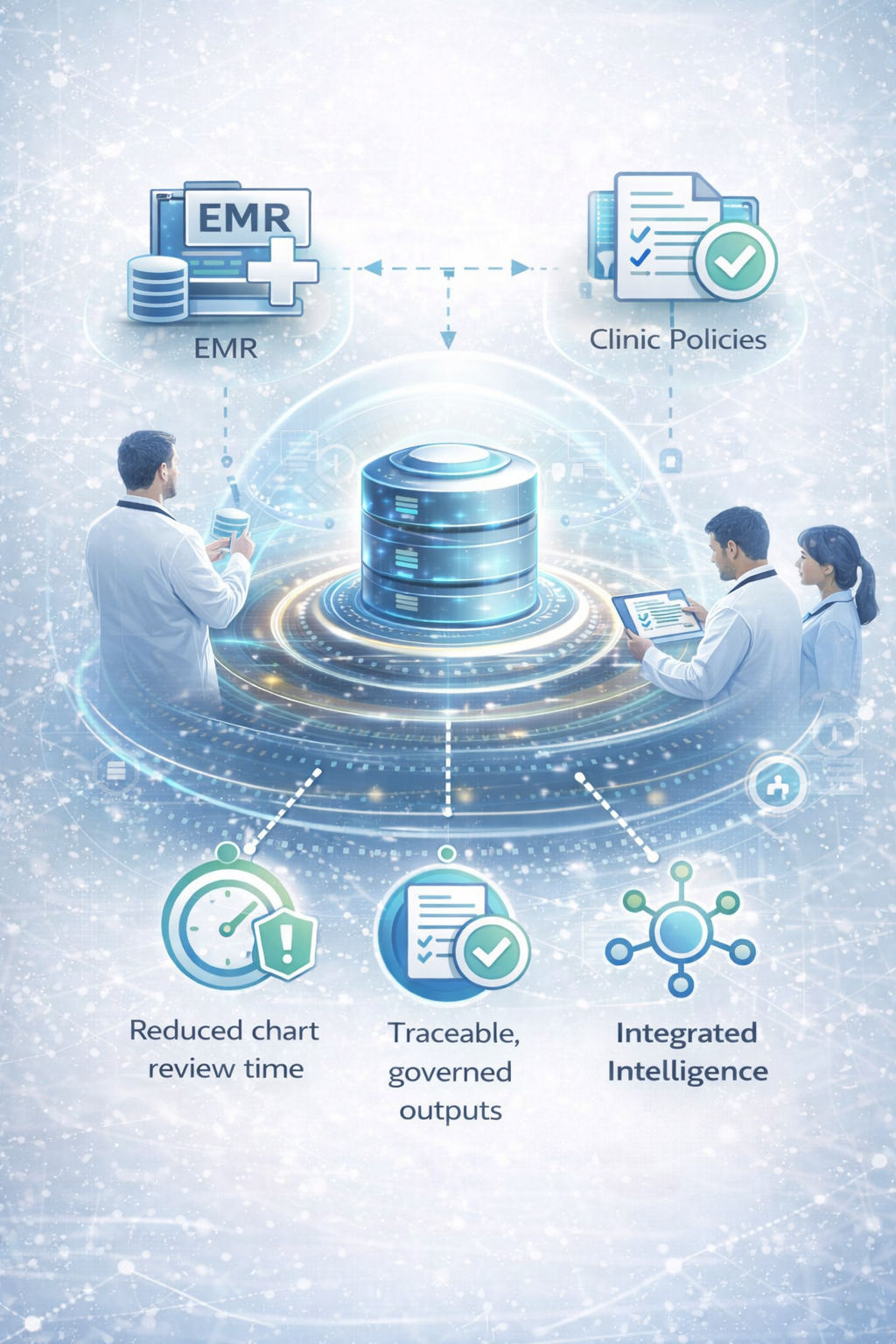
The Dynamic Data Agent enhances clinical operations by transforming fragmented EMR data into contextual, traceable insight at the point of care. Providers spend less time navigating records and more time focused on patients, improving efficiency without disrupting existing workflows. By grounding outputs in clinic-specific data and policies, the architecture strengthens governance, auditability, and documentation consistency. The result is a controlled intelligence layer that reduces cognitive burden, supports informed decision-making, and enables scalable, high-quality care delivery in regulated clinical environments.

  • Reduced chart review time and improved provider productivity.
  • Governance-aligned, traceable clinical outputs.
  • Scalable intelligence integrated seamlessly into existing workflows.
Clinic Impact & Practical Benefits.
From Data Access to Operational Advantage.
Timeline of AI adoption journey from data readiness to continuous improvement.
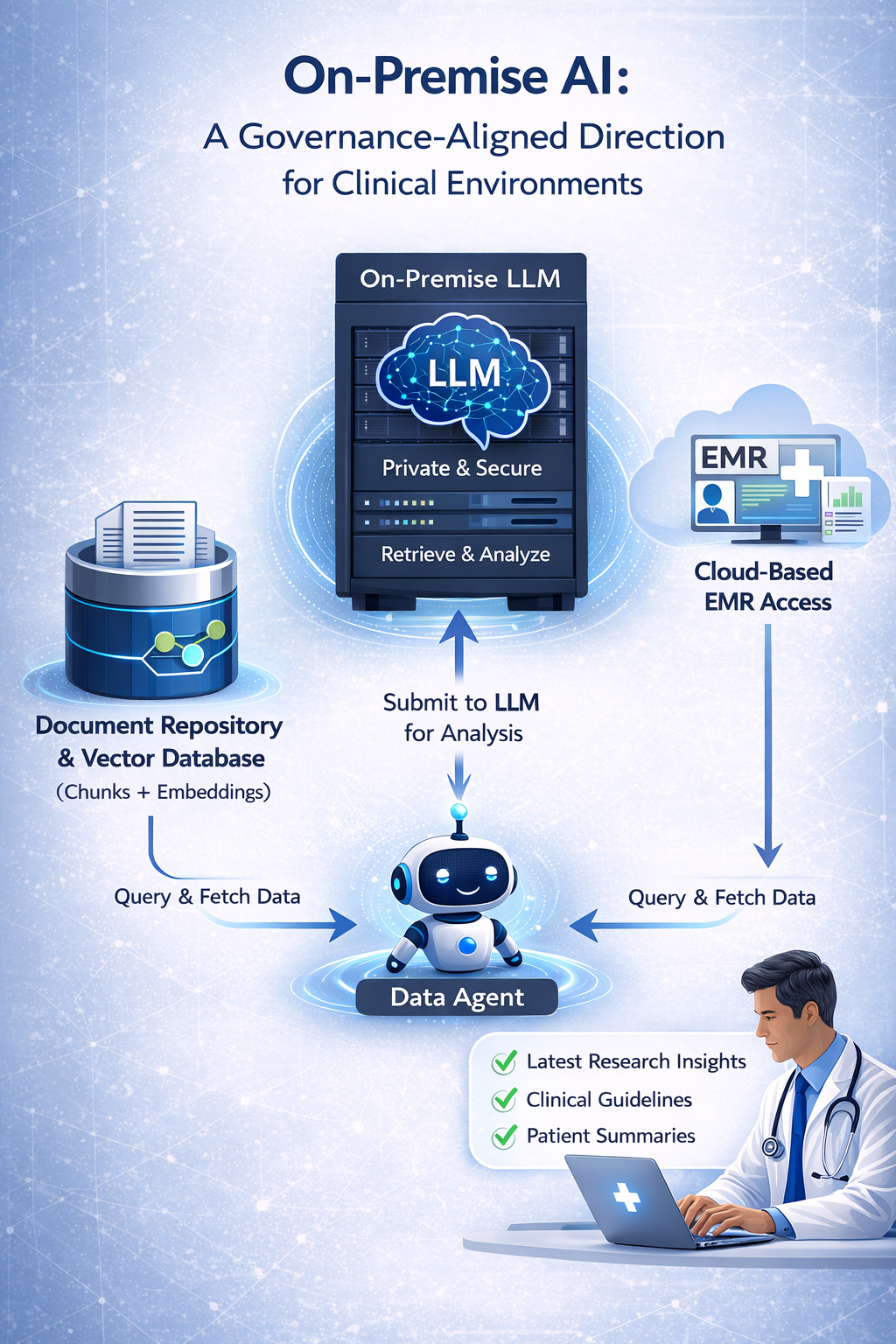
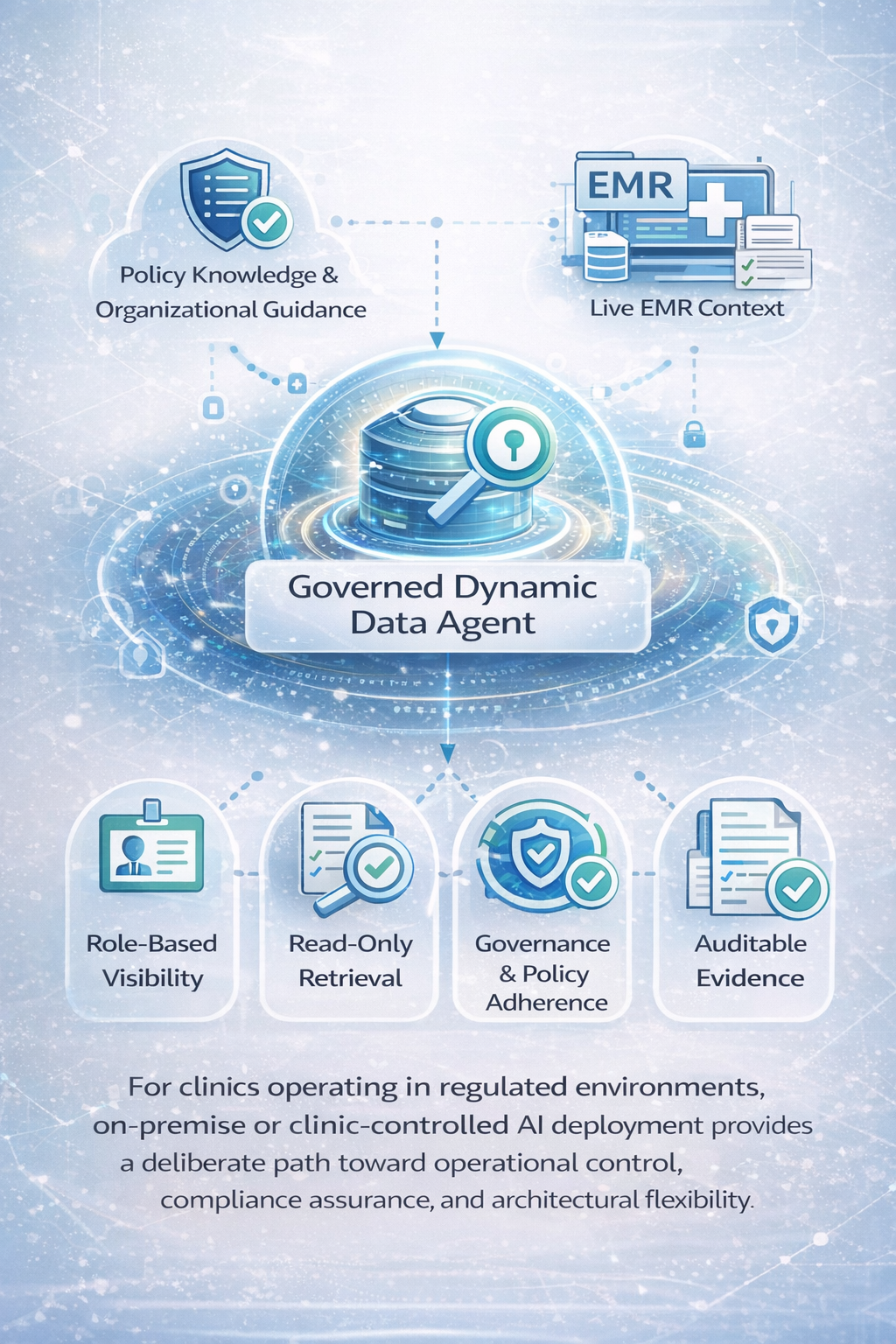
In regulated clinical settings, this architecture depicts a clinic controlled, on-premise AI that performs reasoning and analysis within strict governance boundaries and without direct access to live EMR systems.

Section 06

On-Premise AI: A Governance-Aligned Direction for Clinical Environments

While intelligence at the point of care is critical, how and where that intelligence is deployed determines its long-term strategic value.

For clinics operating in regulated environments, on-premise or clinic-controlled AI deployment provides a deliberate path toward operational control, compliance assurance, and architectural flexibility.

Rather than replacing vendor-provided EMR AI capabilities, a clinic-operated intelligence layer enhances and extends them — aligning outputs with internal policies, specialty workflows, and documentation standards. In highly regulated clinical settings, ownership of the AI intelligence layer is not merely a technical preference — it is a strategic safeguard that strengthens compliance posture while expanding operational flexibility.

  1. Data residency control within defined infrastructure boundaries
  2. Full governance oversight of model behavior, logging, and audit trails
  3. Policy-aligned configuration tailored to clinic protocols
  4. Reduced third-party dependency risk
  5. Seamless integration across systems beyond a single EMR platform

Section 07

What to Ask Before Adopting AI in Your Clinic

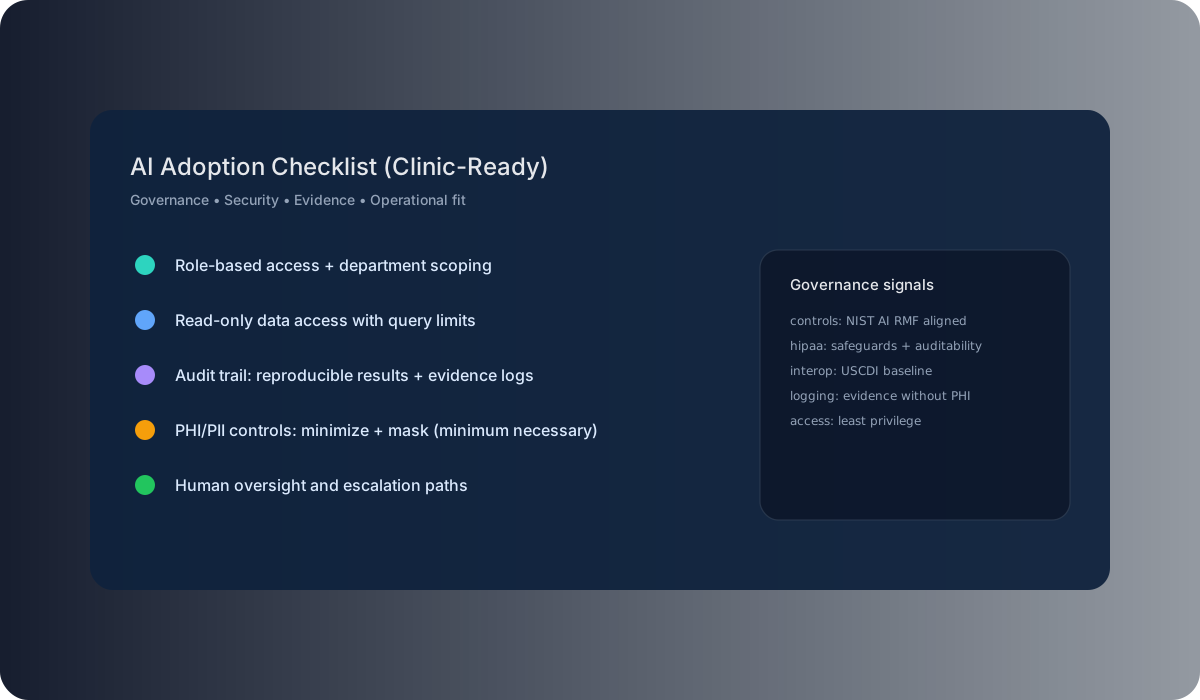
AI is powerful—but it needs safeguards. This section highlights common pitfalls and practical mitigations that keep systems compliant and trustworthy.

AI must not broaden visibility beyond existing policies. Ensure roles, departments, and minimum-necessary exposure are enforced before retrieval.

Require allow-lists, row limits, timeouts, and logging. Avoid any write-back to clinical records unless explicitly governed.

Look for deterministic retrieval evidence, structured outputs, and auditable metadata that supports replay and review.

Confirm masking/minimization controls and that logs capture evidence without storing sensitive content.

High-impact workflows should allow review, correction, and escalation—especially where policy or clinical judgment is involved.

Table listing common AI pitfalls and mitigations such as monitoring, fairness checks, and human-in-the-loop review.
Practical governance: guardrails for quality, fairness, and accountability.

Section 08

Conclusion

Clinics face a growing volume of operational and clinical information, yet staff often struggle to turn that information into timely, actionable guidance. The EMR holds the patient record, and organizational policies define how care is delivered. This reference architecture delineates TraceCounts on-premise AI enablement for clinical settings, modernizing regulated transaction systems for the AI era while emphasizing resilience, regulatory compliance, and enduring adaptability.

Want to explore a clinic-ready Dynamic Data Agent safely?

We design compliance-first AI integration patterns built around governance, auditability, and operational control — enabling clinics to adopt AI responsibly without compromising regulatory posture or workflow integrity.