Insights • AI delivery • Payment Platforms

AI-Driven Transaction Risk Scoring for High-Volume Regulated Payments

Build trust in high-volume digital payments by scoring risk in context—reducing fraud, cutting false positives, and accelerating investigations without ripping out existing systems.

Behavioral analytics Real-time scoring Operational resilience Risk-based compliance

This document presents a conceptual reference architecture developed by the TraceCounts engineering team. It outlines a proposed framework for integrating AI-based risk scoring into high-volume, regulated payment environments.

Overview

Digital payments are growing fast—and fraud is evolving faster. This insights article lays out a practical, phased approach to implementing AI-driven transaction risk scoring that improves detection, reduces false positives, and strengthens risk-based compliance expectations.

Payments & fraud Behavioral analytics Risk-based monitoring Incremental rollout

Section 01

Executive Summary

High-volume payment systems operating in regulated environments must balance fraud prevention, false-positive reduction, regulatory compliance, and transaction throughput. This reference architecture outlines a structured approach to embedding AI-driven risk scoring into existing transaction infrastructures while preserving compliance integrity, auditability, and performance constraints.

  • Fraud losses decline as subtle behavioral patterns become visible.
  • False positives drop, reducing customer friction.
  • Investigations accelerate by prioritizing the right cases.
  • Monitoring scales with volume and supports compliance expectations.

Illustration of secure digital payments: a wallet, network links, and a security shield.
Visual metaphor: “trust at speed” — secure payments at scale.

Abstract stream of transaction data moving through a digital network.
High-volume environments demand risk signals that scale.

Section 02

Industry Context & Problem Landscape

Payment platforms face fraud buried in massive transaction volumes, increasingly automated attacks, and operational pressure to meet risk-based compliance standards.

  • Fraud is accelerating with more sophisticated methods (mules, synthetic IDs, automation).
  • Legacy rule systems create noisy alerts, overwhelming review teams.
  • Manual review cannot scale—forcing painful trade-offs between safety and customer experience.

Section 03

Why Traditional Controls Can’t Keep Up

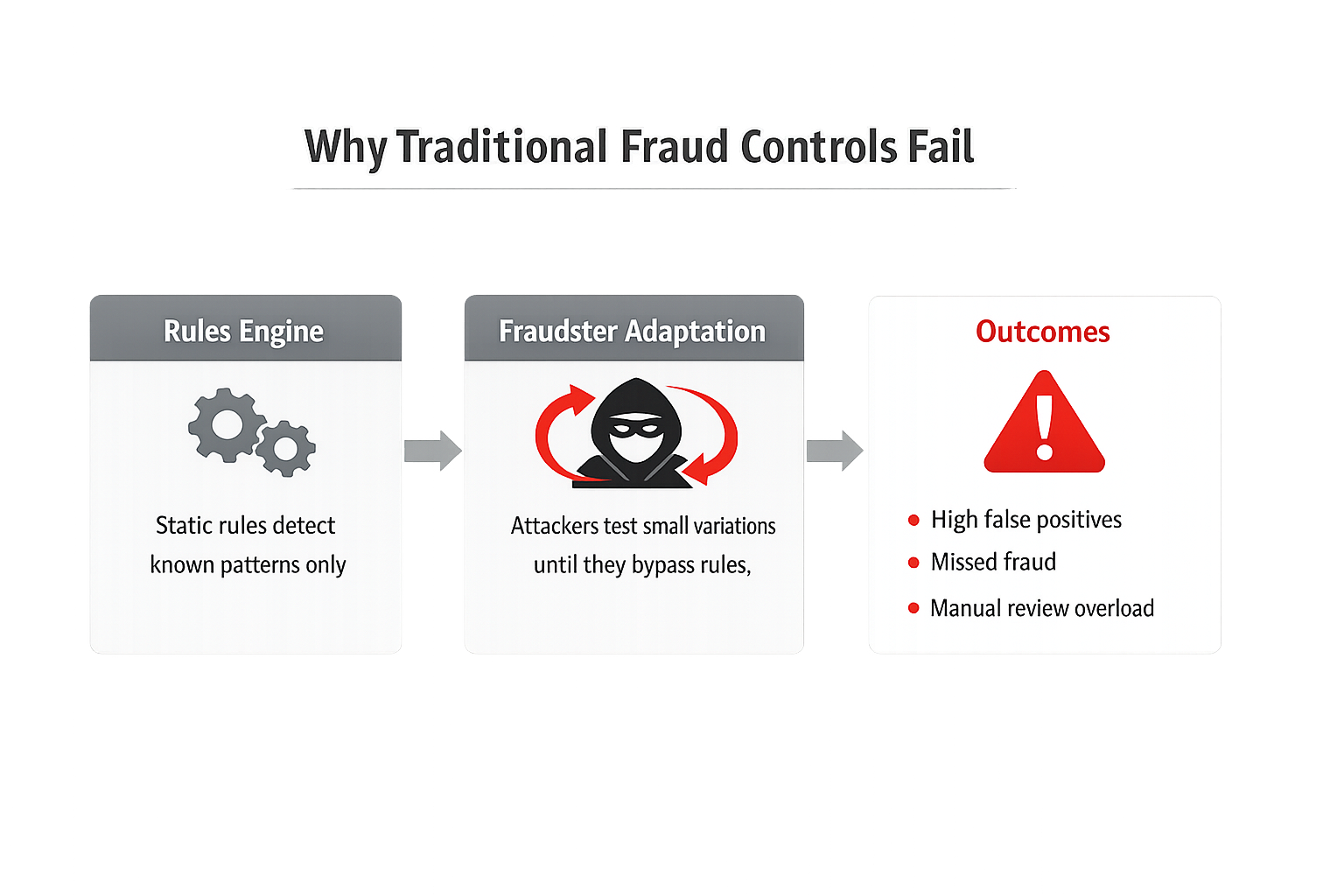
Static thresholds and fixed rules are easy for fraudsters to probe. As attackers adapt, rules become a game of whack-a-mole.

  • Fixed thresholds ignore real user behavior and context.
  • False positives frustrate customers and increase support costs.
  • New fraud patterns slip through before rules can be updated.
  • Subtle behavioral red flags are often missed.
Diagram showing rules engine, fraudster adaptation, and outcomes like false positives and missed fraud.
Rule systems are predictable; attackers optimize around them.
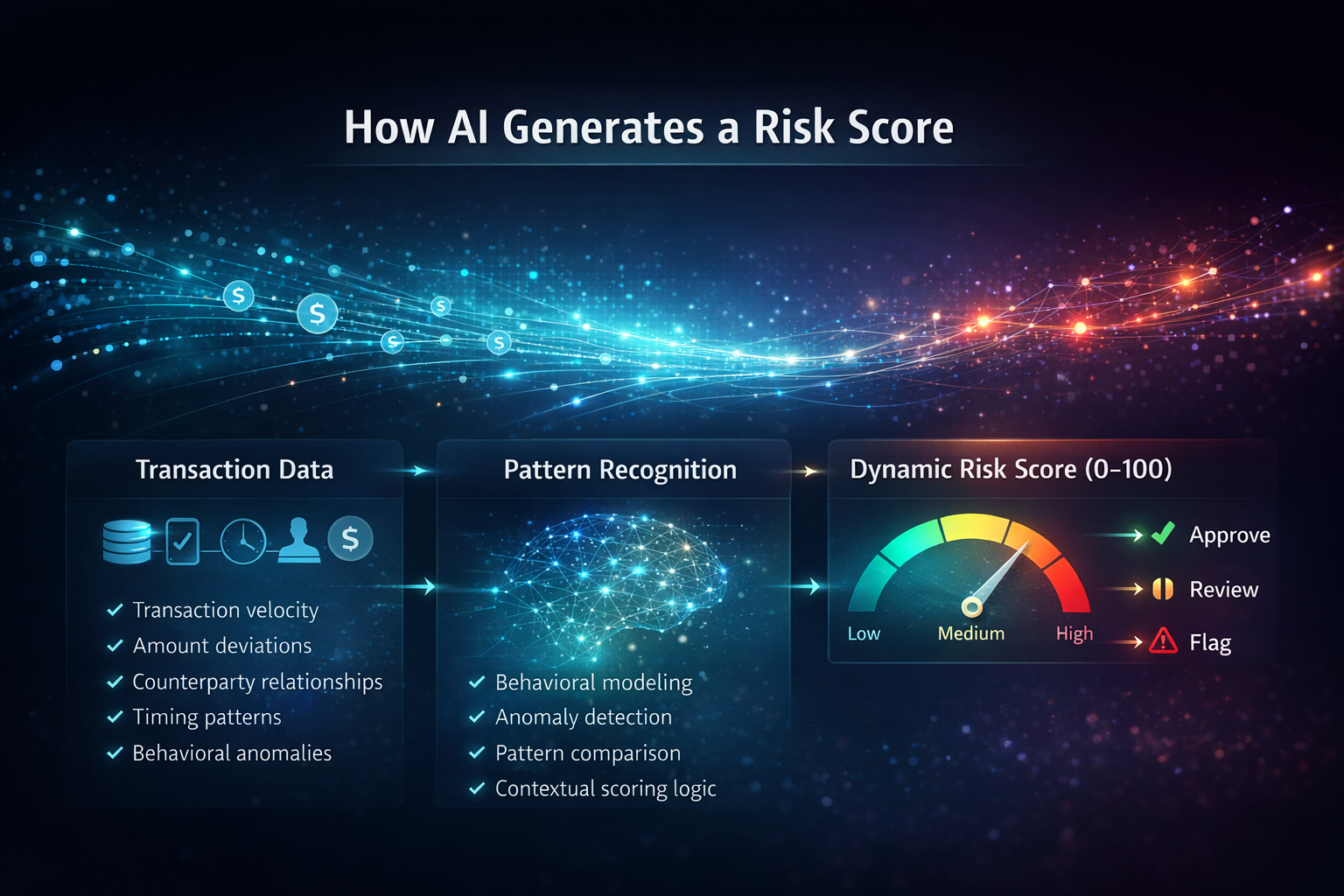
Flow showing transaction data, pattern recognition, and a dynamic risk score gauge from 0 to 100.
Dynamic scoring: context-aware risk for every transaction.

Section 04

Introducing AI-Driven Transaction Risk Scoring

AI evaluates transactions in context using behavioral and historical patterns to assign a dynamic risk score (e.g., 0–100). This enables consistent, explainable triage in real time.

  • Velocity signals (how fast activity occurs)
  • Amount anomalies (out-of-pattern values)
  • Counterparty / network relationships
  • Timing patterns (unusual hours / sequences)
  • Behavioral shifts (sudden change from baseline)

Section 05

Business Impact & Measurable Benefits

When companies move to AI-driven scoring, outcomes improve across the board—fraud reduction, smoother workflows, and better customer experience.

  • Fraud reduction: detect subtle patterns rules miss.
  • Lower false positives: fewer “false alarms” means fewer legitimate blocks.
  • Operational efficiency: analysts spend time on real threats, not noise.
  • Customer experience: low-risk users see fewer delays and declines.
  • Regulatory alignment: supports risk-based monitoring expectations.
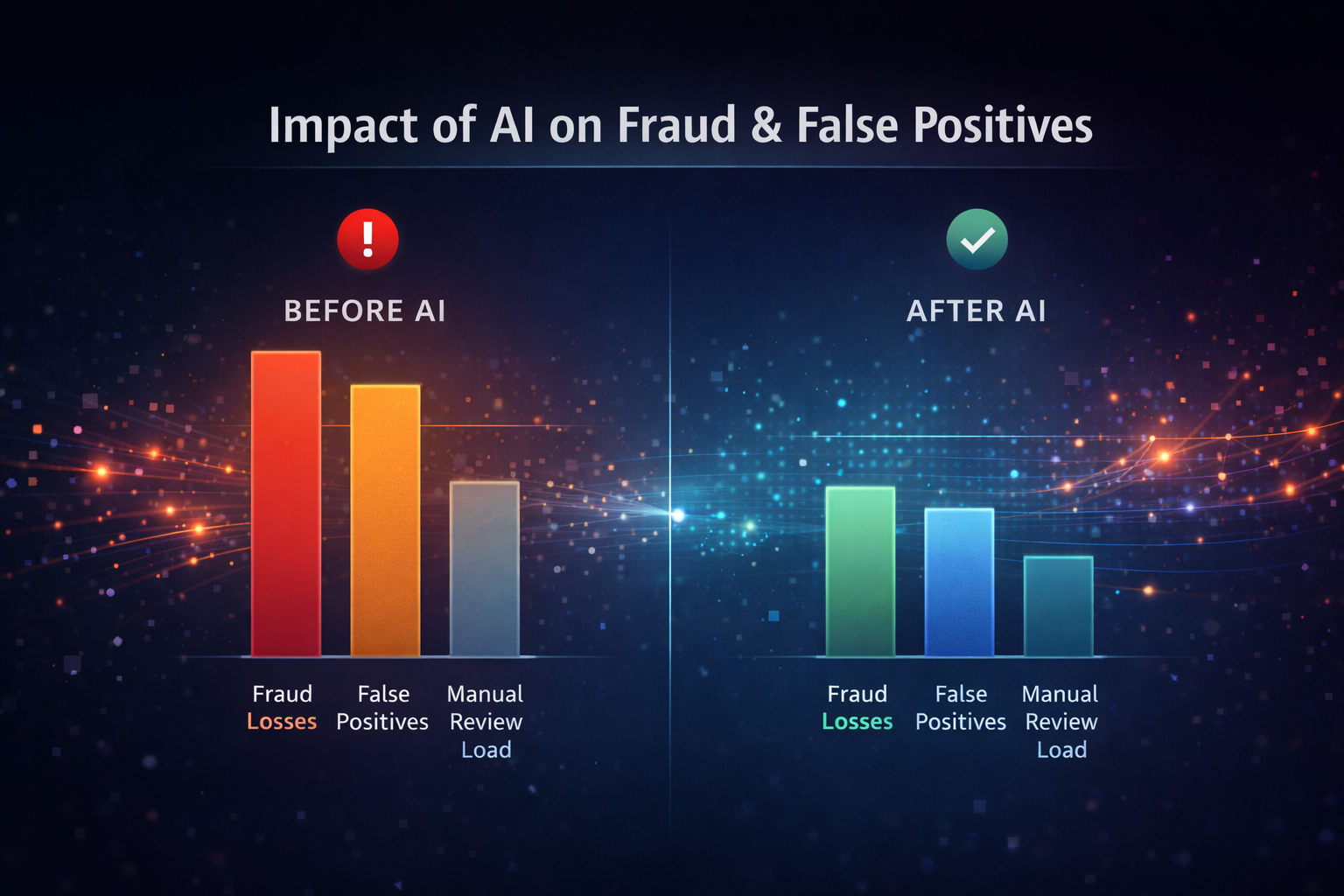
Before and after chart showing reductions in fraud losses, false positives, and manual review load.
Before/after impact: fewer losses, fewer false positives, less manual load.
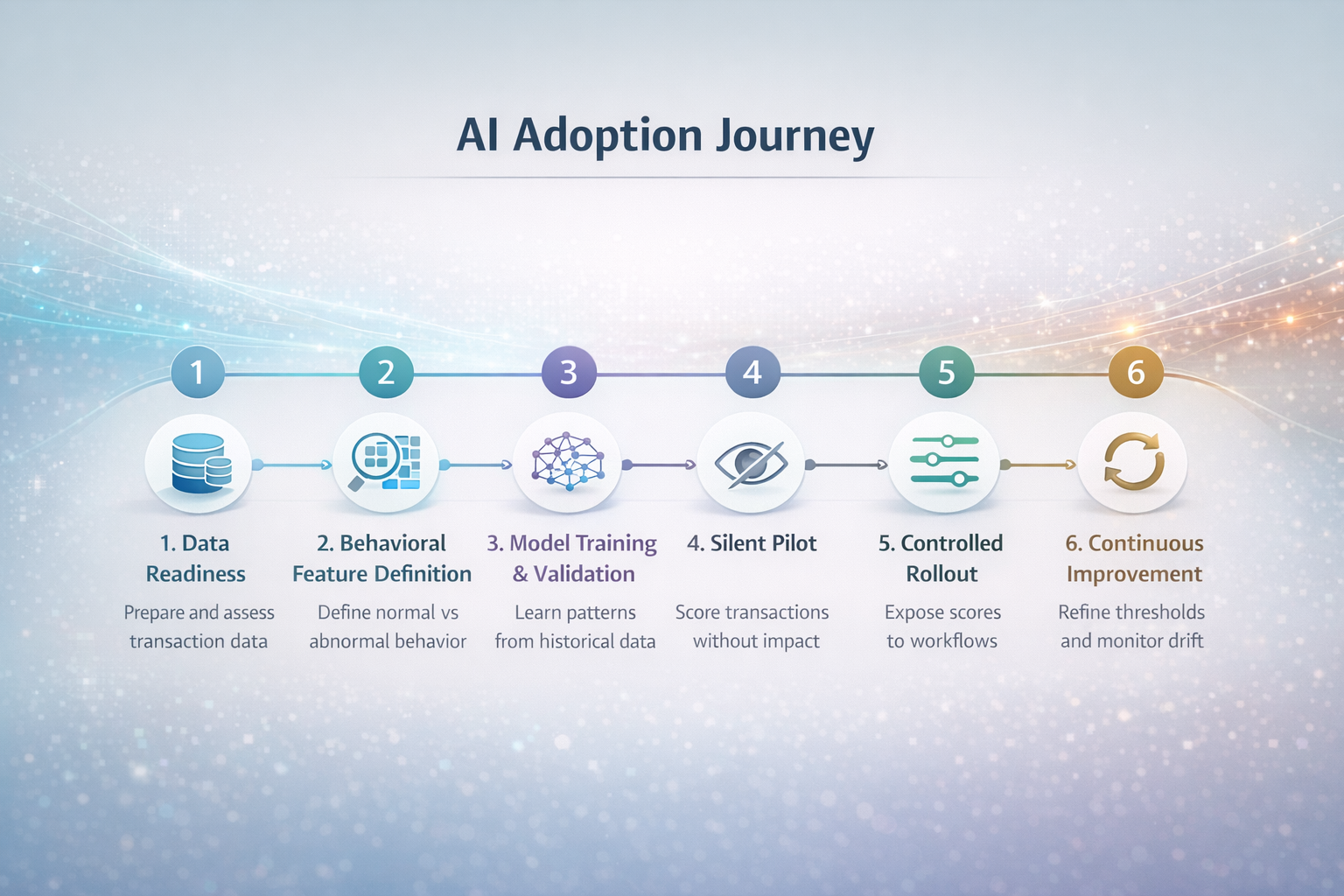
Timeline of AI adoption journey from data readiness to continuous improvement.
Phased rollout reduces risk: pilot silently, then expand with controls.

Section 06

Implementation Approach

Rolling out AI scoring is a step-by-step process that fits regulated environments—start with data readiness, validate carefully, then roll out in controlled stages.

  1. Data readiness: profile, clean, and standardize transaction data.
  2. Behavioral features: define “normal” and model deviations.
  3. Training & validation: learn from historical patterns with strong testing.
  4. Silent pilot: score in the background without customer impact.
  5. Controlled rollout: surface scores in dashboards and workflows.
  6. Continuous improvement: monitor drift, tune thresholds, refresh models.

Section 07

Architecture Objectives

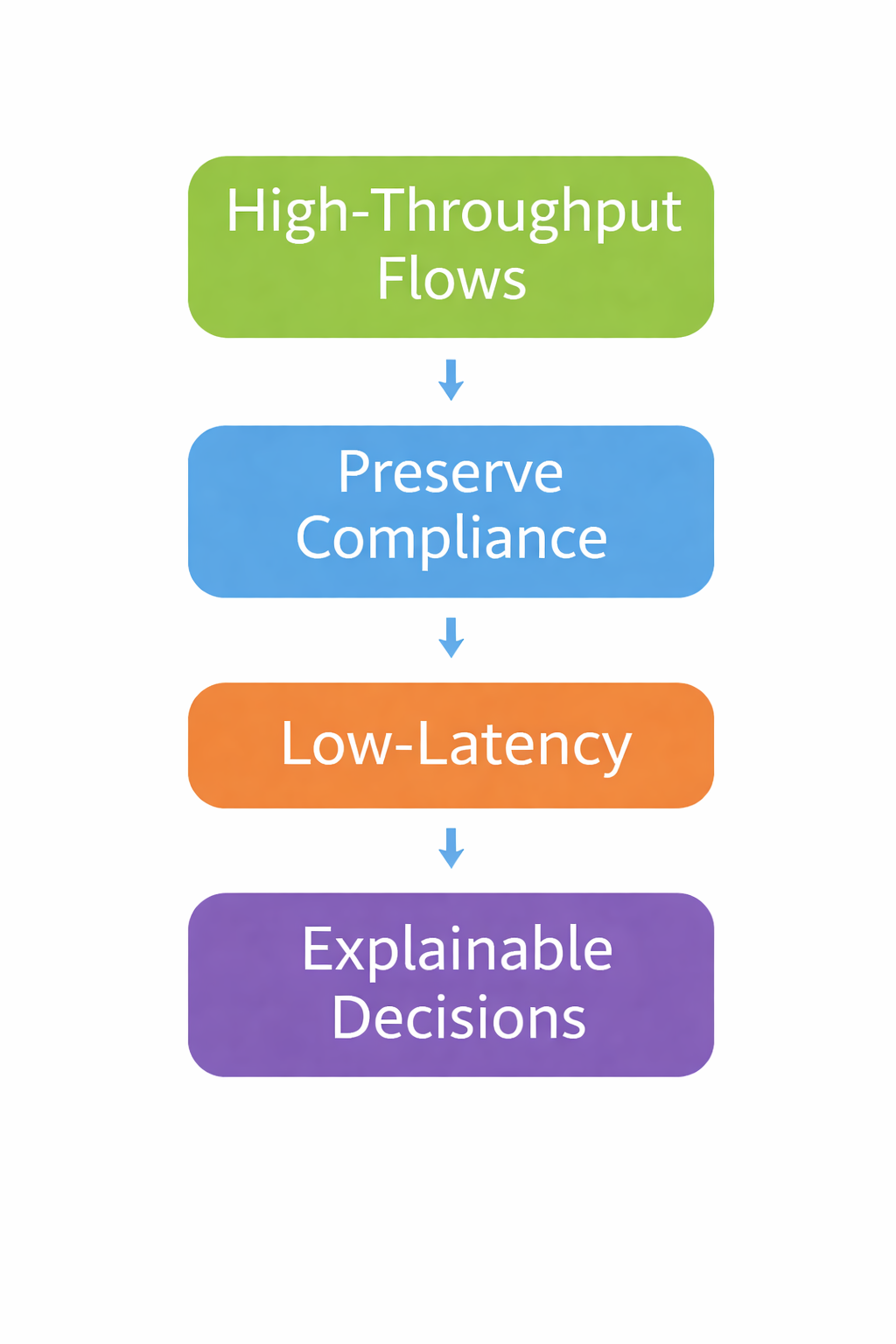
Implement a resilient, low-latency architecture that brings contextual AI risk scoring into high-volume payments, enabling explainable, auditable risk decisions and protecting authorization performance to sustain customer experience.

  1. Introduce contextual AI-based risk scoring into high-throughput transaction flows.
  2. Preserve PCI, audit, and regulatory compliance controls.
  3. Minimize latency impact on transaction authorization paths.
  4. Enable explainable, traceable risk decisions suitable for regulated environments.
  5. Maintain system resilience and failure isolation so core processing remains stable.
Table listing architecture objectives such as resilience, low-latency, explainability, and compliance.
Practical governance: guardrails for quality, fairness, and accountability.
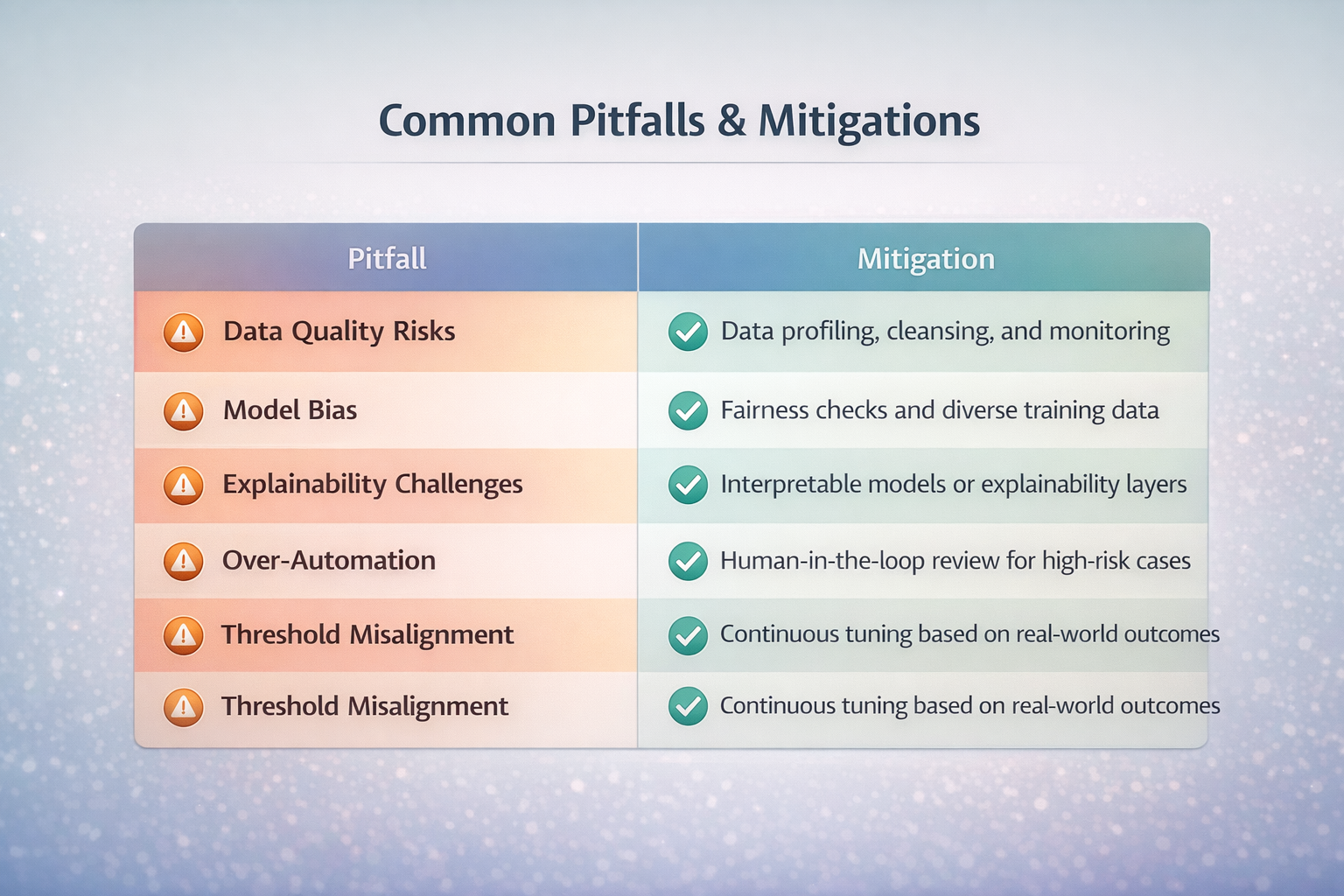
Table listing common AI pitfalls and mitigations such as monitoring, fairness checks, and human-in-the-loop review.
From Throughput to Trust: Architecting AI Risk Scoring for Regulated Payments.

Section 08

Risks & Mitigation Strategies

AI is powerful — but it needs safeguards. This section highlights common pitfalls and practical mitigations that keep systems compliant and trustworthy.

Profile, clean, and monitor data continuously to prevent signal degradation.

Run routine fairness checks and diversify training data sources.

Use interpretable models where possible and add explainability layers for decisions.

Keep people in the loop for high-risk cases and design escalation paths.

Continuously tune thresholds based on real-world outcomes and model drift monitoring.

Section 09

Conclusion

AI-driven risk scoring is becoming the standard in modern payments. Adaptive, behavior-based approaches reduce losses and strengthen trust—while enabling real-time defense as platforms grow.
This reference architecture reflects TraceCounts approach to modernizing regulated transaction systems for the AI-era prioritizing resilience, compliance integrity, and long-term adaptability.

Want to deploy this safely in a regulated stack?

We design incremental AI adoption patterns with observability, controls, and integration safety.

Abstract digital network with icons representing secure data and identity.
Trust compounds when scoring is explainable and operationally resilient.